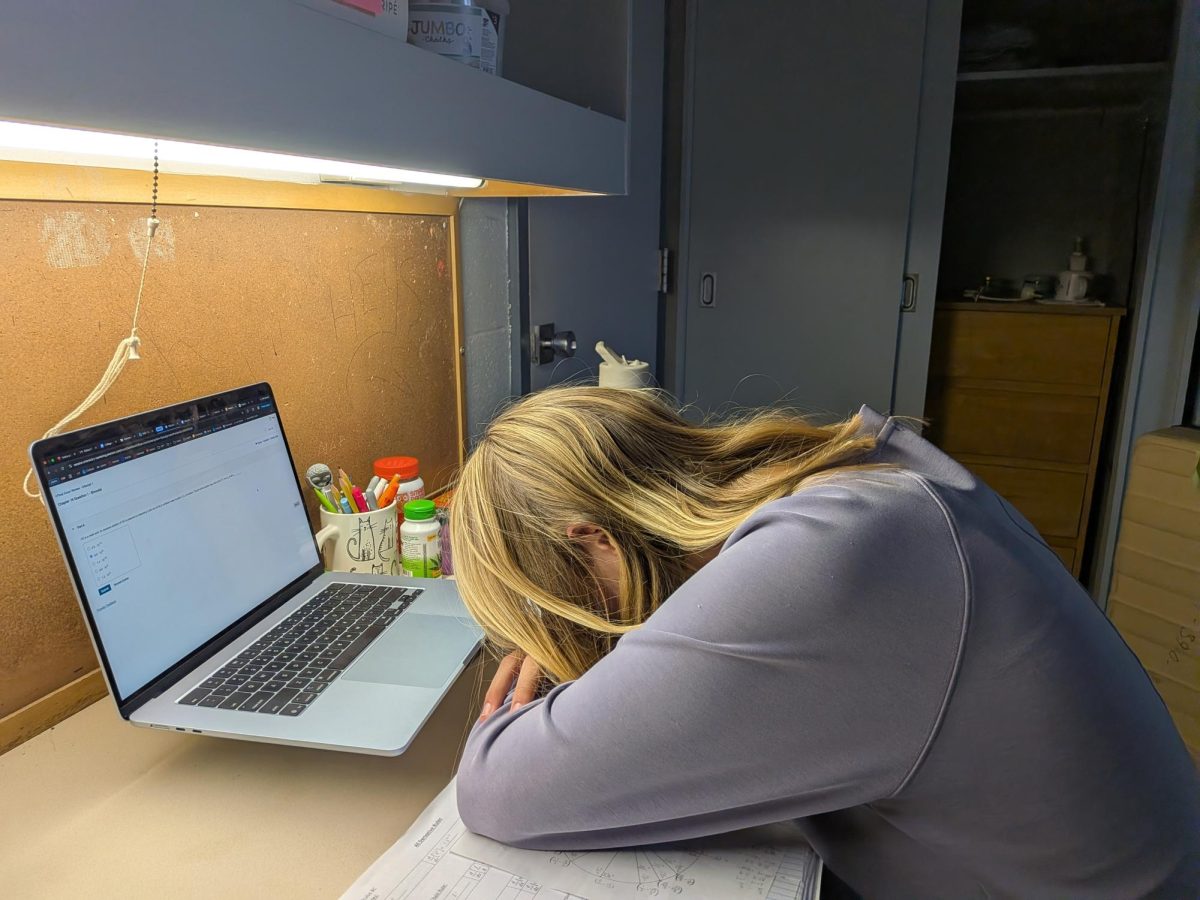
Long after lights-out at MSMS, dorm rooms remain lit by laptop screens and desk lamps as students finish assignments, study for exams and write college application essays. With immense pressure to meet academic expectations, extracurricular commitments and upcoming college applications for seniors, many students sacrifice their sleep to get their tasks done.
According to the Centers for Disease Control and Prevention, teenagers should get at least eight to 10 hours of sleep every night, yet nearly 70% of high school students get less than that, with many high-achieving students averaging five to six hours. At MSMS, similar patterns are shown, where late-night studying and early responsibilities reduce rest, turning sleep into an undervalued resource.
This lack of sleep creates a measurable gap in academic performance. Research from the National Institute of Health found sleep deprivation reduces learning capacity by 40%, while also impairing focus, decision making and memory recall. For MSMS students, this means despite the long hours of studying complex subjects such as physics, calculus and more, their ability to retain and apply the information is significantly weakened.
Even though more time and effort are spent toward class work and studying, the cost of sleep takes its toll on actual academic performance. To support this, findings from the American Academy of Sleep Medicine revealed students who get insufficient sleep experience lower grades and a lack of classroom engagement. At several schools, this often appears as fluctuating test scores, decreased participation and a heavy reliance on extended study hours that further reduce rest.
Junior Christopher Chen said both the amount and quality of sleep can affect his ability to focus and learn in class.
“I think the amount of sleep you get really does impact the quality of your learning. Whenever I’m lacking in sleep, it gets harder to concentrate and stay focused in class. My mind is just focused on things other than the lecture material,” Chen said. “Even if you sleep seven to eight hours a day, you have to look at whether or not you’re getting high-quality sleep or if you’re sleeping really late past midnight.”
Chen’s experience is not isolated to only MSMS but reflects a broader pattern across Mississippi. Statistically, sleep schedules in the state are worse comparatively worse off. Data analysis from the Mississippi State Department of Health ranks Mississippi among the states with the highest rates of insufficient sleep, reinforcing the broader challenges seen at school like MSMS.
Many students in the state balance school with responsibilities such as extracurricular activities, family obligations or part-time jobs. In rural areas, long commutes and early bus schedules limit sleep opportunities. In this context, MSMS represents an intensified version of a statewide challenge.
Beyond academics, the effects of sleep deprivation extend to mental and emotional well-being. Students may experience increased stress, burnout, reduced motivation and more demonstrating the challenges seen in an overworked school setting. In a residential setting like MSMS, this can also impact peer relationships and overall community health, weakening support systems essential for success and overall well-being.
Junior Daniel Hu said sleep deprivation has not significantly affected his academic performance, but it has negatively impacted his physical and mental health.
“I typically sleep around six to seven hours a night, but there are times when I sleep only four to five hours at MSMS,” Hu said. “Personally, I don’t think my sleep schedule has really affected my grades that much during this school year; however, I do think it has affected my performance in other areas.”
The sleep deprivation problem at MSMS isn’t unique to the school alone but represents a broader problem in the state. Within such a demanding academic environment, sacrificing sleep may seem like an important step toward success, but in reality, it hinders the very performance students are trying to improve.
When sleep is constantly lost, students’ ability to focus and retain information begins to decline. If effort is put in, the solution is clear: Sleep must be treated as an important resource, not expendable time to waste. Without protecting this resource, both individual achievement and the overall effectiveness of the school will suffer, limiting the full potential of students at MSMS and across Mississippi.