
Throughout November and December, the MSMS Student Government Association Senate proposed and debated on legislation ranging from regulating student work service assignments to an updated SGA Constitution presented by SGA President John Broome.
The months’ Senate sessions ended with a surprise Christmas party hosted and paid for out of pocket by the SGA officers and cabinet members for senators and meeting attendees.
The Legislation
Beckman and Maksi introduce bill to add kitchens to list of common areas in student handbook
Sens. Isabel Beckman and Noah Maksi proposed a bill to include kitchens in both residential halls to the list of common areas listed in the student handbook. Previously, policy on kitchen availability and required cooking utensils had not been included in the handbook. Included in the bill were a list of kitchen essentials the residence halls would be required to keep available.
Sen. Landon Rymer voiced his support for this bill and said, “I think it’s important to have a regulated system of stuff in the kitchens so students know what they can use and they’re not repeatedly buying stuff like utensils, spices or other high use-to-cost ratio items every time they use the kitchen.”
Their bill was passed by the Senate but tabled by administration, citing the obligation the school would have in supplying the materials in the kitchens, which currently operate on a donation-based system.
Mantri, Uppu introduce bill regulating how work service is graded
Sens. Ananya Mantri and Tejasvi Uppu proposed a bill to create a rubric for work service, citing anecdotal evidence of discrepancies between work service grades across buildings at MSMS and the quality of the completed job. In theory, the bill would help hold everyone to the same standard across all work service assignments. The proposed rubric grades students on attendance, work ethic and quality, with 5, 3 and 2 points achievable for each category. The sum of all three categories would then determine the work service grade.
Maksi supported the bill and said work service in Frazer Hall gives sub-perfect grades for work service regardless of the job done and the rubric would guarantee a student receives adequate credit for the work service they did.
Their bill was passed by the Senate but was tabled by administration, who emphasized each work service assignment had its own overseer who may prioritize one aspect over another, and assignments varied so much that expectations for them were too nuanced for the rubric to work effectively.
Giesen introduces resolution to reintroduce Pledge of Allegiance in accordance with state law
Sen. Walt Giesen proposed a resolution for MSMS to return to complying with the Mississippi Code § 37-13-7, which requires all public school students to recite the Pledge of Allegiance at least once a month to the best of their school’s ability. The resolution stated the Pledge would be recited once a month underneath the Hooper Academic Building’s American flag at a time decided by administration.
His resolution was passed by the Senate and administration, who said the change would be made in the handbook in January.
Germany, Tran introduce bill to allow work service roles to rotate midway through the year
Sens. Connor Germany and Khang Tran proposed a bill to give all students a new work service after the first semester and allow them to rank their preference of work assignments, citing primarily the inequality of difficulty of certain jobs over others and the inability to change out of them.
Sen. Alexis Freeman brought up a concern within this bill, stating Goen Hall Director and Residence Life Coordinator LaToya Bledsoe already has a system in place within Goen Hall where work service assignments are switched per semester. Freeman also stated work service assignments in both Hooper Academic Building and Shackleford have their own system as well. She notes that it appears only Frazer Hall does not have this system in place. Sen. Minh Nguyen supported this bill but made an amendment so students assigned to work in Hooper or Shackleford would be rotated out every quarter. Sen. Jaelyn Lister disagreed with the idea of allowing students to rank their preferred work service assignments, stating that it would burden the administration with more responsibility.
Their bill was passed by the Senate but was tabled by administration, who did not see a clear benefit to trading work service positions, as it would require retraining students and, in some cases, result in little to no change in the type of work done.
Nguyen introduces resolution to bring back the Mother’s Day extended weekend
Nguyen proposed a resolution to reimplement an extended weekend for Mother’s Day. The extended weekend would allow students to take their belongings home to make the end-of-the-year move-out day less of a hassle. By allowing students to remove excess belongings before exam week and the final move-out day, Nguyen states it would lower the stress of a busy packing process before exam season begins.
Sen. Annaliese Coughlin opposed this resolution due to the forced shift in the environment just before exam season. Going home to a more relaxed environment and then coming back to school makes it difficult to adjust the mind back to academia. Both Sen. Jolanna Jackson and SGA sponsor Chuck Yarborough agreed with Coughlin.
His resolution was failed by the Senate.
Coughlin introduces bill to excuse students from room checks if resident assistants are late
Coughlin proposed a bill to allow students to leave their keys and IDs by the door if a resident assistant is more than 15 minutes late to room checks. Highlighted as a recurring issue, students can be left standing in the hallways long after the time room checks are scheduled passed, taking away valuable time from students for fear of ramifications. Her proposed legislation would allow students to leave their keys and IDs in plain view and step away from their door if a resident assistant fails to conduct room checks within 15 minutes. She clarifies that this change will not apply to room inspections, in which the cleanliness of the rooms is assessed.
Freeman expressed her support for this bill, stating she had a resident assistant who was 30-35 minutes late to room checks, and she had a test to study for that same night. Sen. Anya Rai agrees with Freeman, stating she didn’t think it was fair for students to be inconvenienced in this way when resident assistants are tardy.
Her bill was passed by the Senate, but was failed by administration, who did not feel this needed to be included in the handbook as it is primarily a personal issue. They instead recommend that specific instances be reported to them or residence hall directors so they can be addressed. However, if the issue persists, the bill should be reintroduced for consideration.
Savage introduces resolution to allow band concerts to count as wellness hours
Sen. Amaya Savage proposed a resolution to allow students to receive wellness hours for performing music at concerts. She noted that the current policy allows Tales from the Crypt students to receive wellness for performances, but students who participated in a Veterans Day concert could not.
The chamber made little notes, and her bill was passed by both the Senate and administration, who had no issues with the bill.
Desai, Ao introduce bill to reimplement Mental Health Days at MSMS
Sens. Krish Desai and Johnny Ao proposed a bill to reintroduce mental health days and establish safeguards to prevent policy misuse. Mental Health Days were removed in the past due to academic misuse, but the need for mental wellness support remains significant in a rigorous academic environment. As per this bill, students will be allotted one MHD per quarter, with several restrictions: MHDs must be requested at least two days prior, cannot be carried over between quarters or used right before a quiz, test, exam or other major assignment. Additionally, students must follow standard absence procedures for missing classes. Outlined appropriate uses of MHDs include wellness activities such as sports or resting in the dormitories.
Rai liked the limitation of giving students only one MHD per quarter and noted that having a day to themselves isn’t something MSMS students get very often. Savage personally talked to counselors about MHDs and liked the idea of not letting students take them on test days. Mantri supported this bill as well but stated planning MHDs days in advance seemed unnecessary and students should just be able to go downstairs within residence halls and request one.
Their bill was passed by the Senate but was tabled by administration, who expressed concern about making the mental health process overly rigid. They stated they preferred a more individualized and autonomous process, prioritizing flexibility for students. In summary, they did not see a clear need to make the mental health process more restrictive.
Jean-Pierre introduces bill providing a grace period for students returning on yellow card
Sen. Angelle Jean-Pierre proposed a bill to provide students a grace period of 10 minutes to account for traffic or minor delays when traveling off campus and signing out on yellow cards. She stipulated a student should still notify the dorms, and this policy would not apply if a student estimates their time of return to be right before curfew. This policy intends to give students grace so they are not rushing to get back and can return safely.
Sen. Jaelyn Lister supported this bill, stating this inclusion in the handbook would make the policy more concrete. Sen. Ryan Wei, however, noted students can always just call the Residence Life Office to extend their sign-out time.
Her bill was passed by the Senate and administration. It will be included in the handbook, and administration noted if students are concerned about being late, they should still notify their respective residence halls.
Lister, Freeman introduce bill outlining, clarifying how room inspections work
Lister and Sen. Alexis Freeman proposed a bill to clarify how the timing of room inspections before holidays and extended weekends may vary at the discretion of Residence Life Hall Directors within the handbook. This addition to the handbook seeks to aid and inform future students on evolving policies surrounding room inspections.
The chamber made no comments and immediately passed the bill. Administration, however, tabled it. They did not see a clear reason for this amendment to be included as the information is already communicated through the Residence Life staff. They were also confused by the wording and requested further clarification.
Thompson introduces resolution recognizing hard work of cafeteria employees
Sen. Lillie Thompson proposed a resolution to recognize the positive impacts of the Hogarth Dining Hall staff and foster greater appreciation within the school community. This resolution pushes for formal acknowledgment of cafeteria staff by creating a quarterly recognition program aimed to boost staff morale, student gratitude and positive relations between staff and students. Her resolution requests the establishment of a Dining Staff Member of the Quarter Award, facilitated by students and awarded based on a schoolwide poll. The award includes but is not limited to a certificate of appreciation, a formal announcement of the quarterly winner and possibly a small display placed in the cafeteria honoring that month’s staff member.
The chamber made no comments and immediately passed the resolution. Administration passed this legislation as well and requested to know if Thompson would like to expand this resolution to include individuals who work at the police station, library, mailroom and others and present the award once a month instead.
Broome introduces updated constitution
Broome presented an updated constitution to the chamber. Along with minor changes to campaigning rules and SGA officer responsibilities, major changes include adding representatives to the Senate and giving the SGA president the power to exercise executive orders. In total, there will be four representative positions in the chamber, and elections will occur at the beginning of the second, third and fourth quarter. They are allowed to present and debate on legislation, but they will not be allowed a vote. Additionally, they are subject to the same legislation and attendance requirements as senators.
The chamber made no comments and immediately accepted the changes. The new constitution is now ratified.
Wei introduces bill to alter wellness requirements for athletes
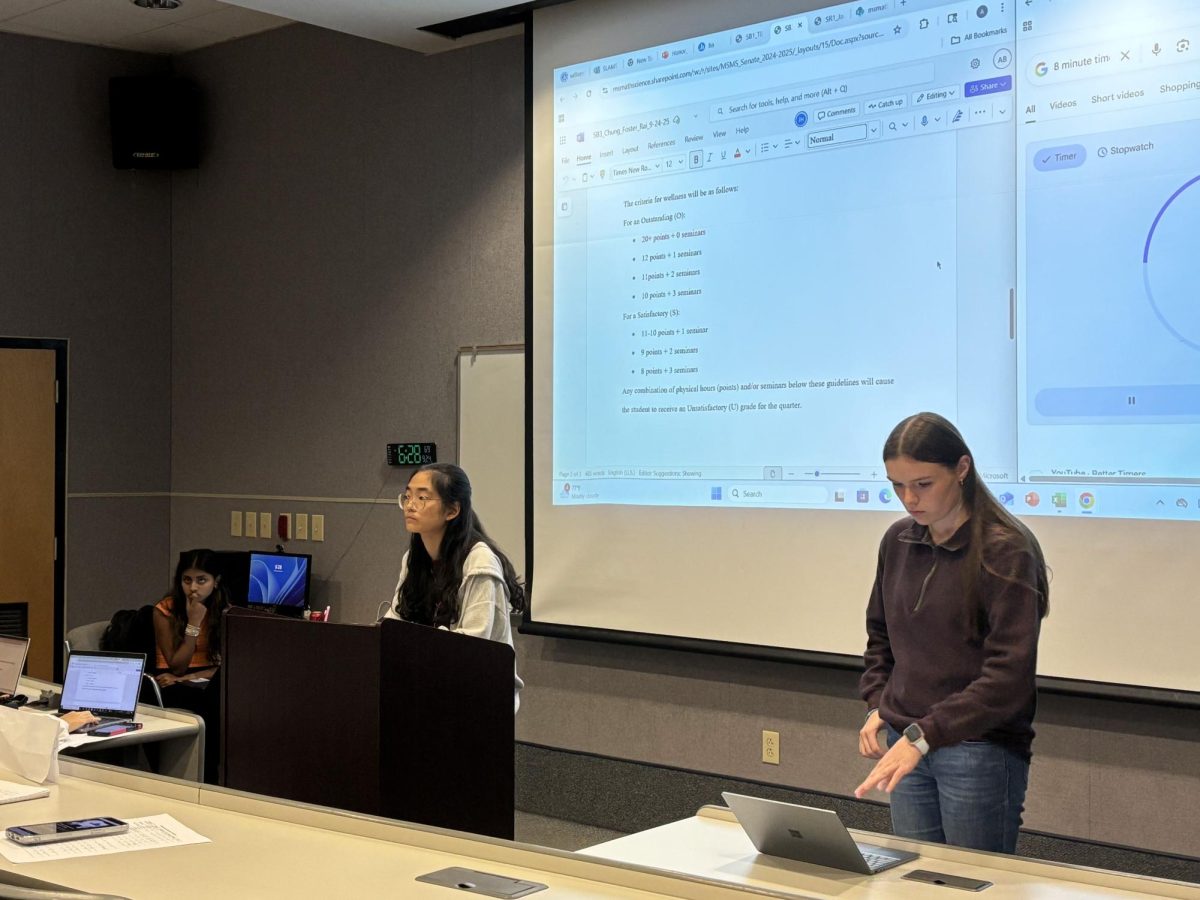
Wei presented a bill to limit the amount of attainable wellness hours for athletes from participating in a sporting event in exchange for a single wellness seminar credit. The reasoning lies in athletes signing out for sporting trips for up to 10 hours, while the actual activity may only last a couple. Additionally, student-athletes being away for sports can cause them to miss out on wellness seminars. Thus, this bill would limit athletes to receiving six hours of wellness credit in total for participating in a sport or multiple sports each quarter. In exchange, one wellness seminar credit will be given for participating in a single sporting event once per quarter.
Sen. Daniel Hu said one seminar wasn’t enough to make up for the lost hours being away from school and made a suggestion to allow student-athletes to receive a wellness seminar each time they attended a sports event, which was rejected. Sen. Anna Anderson also opposed this bill, stating she felt student-athletes earned their hours “fair and square.” Sen. Katie Chung supported this bill, stating it would make it easier for student-athletes to receive seminar credits while also getting ample wellness hours. Sen. Anya Rai supported this bill as well, citing it would be beneficial for athletes and would not negatively affect the rest of the student body.
His bill was passed by the Senate but was tabled by administration, who expressed concern that activities such as band, cheer, and other programs were not included under this policy, resulting in an unfair advantage for those in athletics.
Editor’s Note: Co-Editor-in-Chief Walt Giesen contributed to this article.