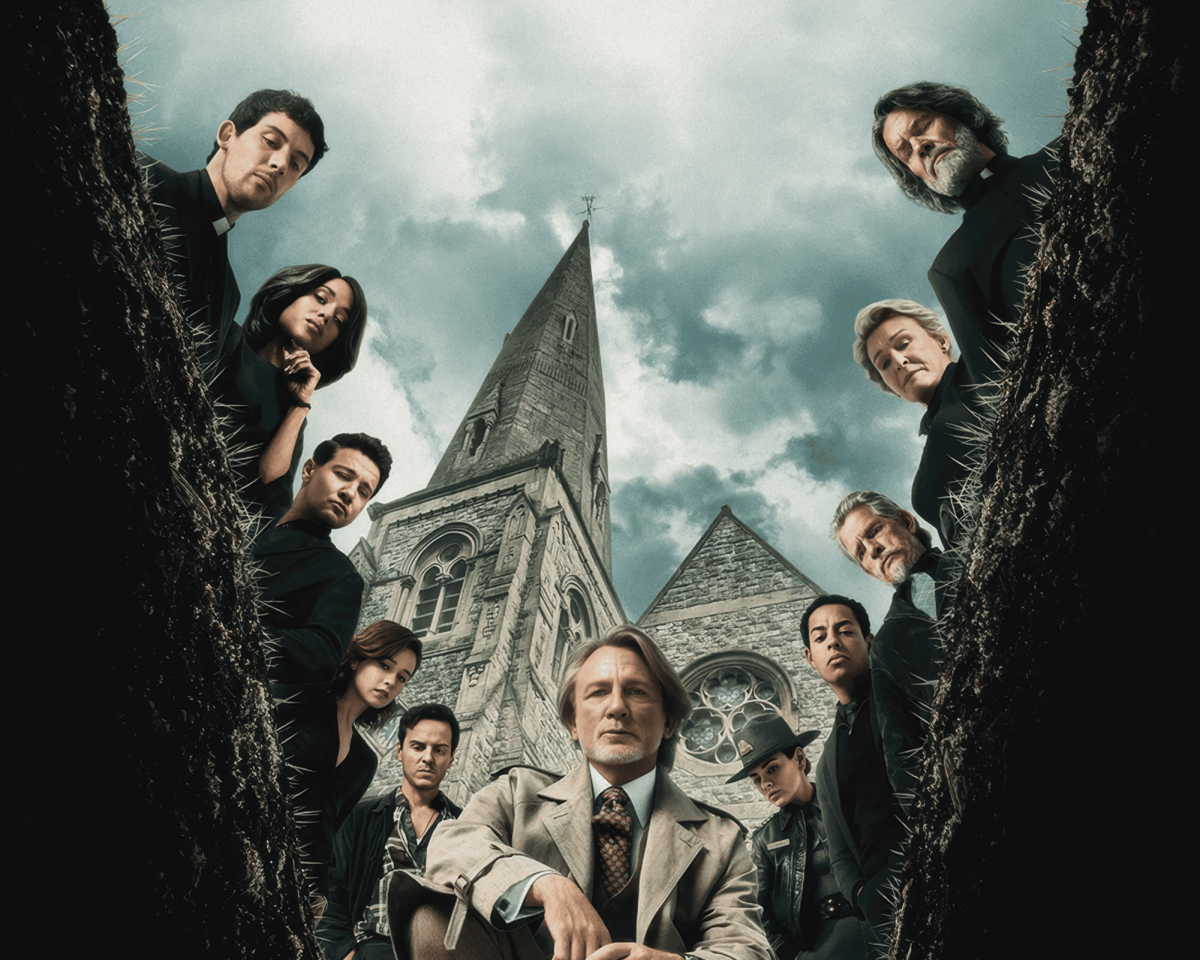
Six years after “Knives Out” was released, “Wake Up Dead Man: A Knives Out Mystery” manages to leave the audience with another thrilling, grand mystery.
“Knives Out” has been repeatedly praised for its cunningly crafted mystery with a distinct array of personalities. When “Glass Onion: A Knives Out Mystery” came out three years later, it received similar praise. It’s no surprise the third installment continues to live up to the name.
“Wake Up Dead Man” is a murder mystery set in a Catholic church in New York. It begins similarly to “Knives Out” with the audience being introduced to the context through flashbacks. Here, we’re introduced to our fresh, fun cast of characters. Father Jud Duplicity, played by Josh O’Conner, is a priest who formally boxed until he killed a man in the ring. Duplicity is sent in punishment to the Catholic church, Our Lady of Perpetual Fortitude, which is run by Monsignor Jefferson Wicks, played by Josh Brolin. Mons. Wicks looms over the entire church with his fire- and-brimstone sermons and gathers a cult-like following, which becomes the main suspect after an impossible murder is committed.
The story proceeds like the first two movies, with Benoit Blanc, played by Daniel Craig, swooping and scurrying around, searching for clues and slowly peeling away the onion of a mystery. The issue of this murder is the impossibility of it. Blanc uses the book “The Hollow Man” as a baseline for solving this “locked door” mystery. Blanc and Duplicity travel along the grounds and local towns as the mystery continues to prove its insolvability. This is until the grand finale, where all the pieces fall neatly into their place and a confession occurs.
The bones of this story share much similarity with both “Knives Out” and “Glass Onion” yet still stand out. The director and writer, Rian Johnson, managed to utilize the same framework for another amazing murder mystery, without it being repetitive.
Modern movies are faced with copy-and-paste plot lines with predictable endings, so how has Johnson made it work? Experiencing “Wake Up Dead Man,” having previously watched “Knives Out” and “Glass Onion,” made it easy to pick out the patterns. The audience knows the ending will involve a grand reveal of how the truth was hidden beneath our noses. The social commentary humor remains the same, with similar jabs at society through right-winged characters who come straight out of a tweet.
But Johnson changes the makeup of the mystery every time, giving us a new present to unbox. Consider puzzles — each one contains pieces of rather similar shapes and amounts, but with differing images from puzzle to puzzle, creating a sense of complete novelty each time. The pieces are the framework for Johnson’s movies, but the mystery is the image.
Throughout each movie, Johnson points out a modern issue in society. In “Knives Out,” he uses dialogue centered around the main character, who is an immigrant, to capture the heated debate around immigration. In “Glass Onion,” Johnson comments on the wealthy, over-extravagant lifestyle of tech industry CEOs.
Johnson amplifies this trait in “Wake Up Dead Man” by using the modern tension around authoritarian governments and using manipulation and fear to create a cult-like power. He does this specifically with his character Wicks. Cy, the want-to-be MAGA politician in Mons. Wicks’ flock, explains to Mons. Wicks in a scene the power his hellfire sermons hold. He goes further and describes how he has radicalized his small group, but there isn’t enough fuel in just them; however, by utilizing the internet, he can expand his power.
Johnson also focuses on the power of the internet in “Glass Onion” through his conservative influencer, Duke. His trend of using right-winged characters to add in modern conflicts is another similar thread throughout the movies; however, it isn’t overdone to the point of boredom. He plays the same trick of adjusting the image of the puzzle just enough for it to still have the feeling of novelty.
Compared to “Knives Out” and “Glass Onion,” “Wake Up Dead Man” focuses on religion and takes an inner approach. Johnson expressed in an interview how this was the intention. In the first scene with our two main characters, Duplicity and Blanc, the debate of Christianity is introduced. Johnson stated the debate was a way for him to take his inner thoughts out. In the scene, Duplicity convinces Blanc to be honest in his opinion of the church. Blanc complies and begins on his cynical rant about the architecture attempting to tell him a story of Christ, which he doesn’t believe. The light from the sun outside dims as he points out the issues and the fakeness of it. Only when Duplicity presents an argument about how the storytelling may be profoundly true does the sun shine back in, illuminating the scene.
“Wake Up Dead Man,” along with “Glass Onion,” proves a copy-and-paste plot line can work extremely well with how it is executed. Maybe once Johnson is five or seven movies in, the structure of these films will begin to feel too repetitive if his puzzle method doesn’t hold up, but will the faithful audience accept something that deviates from the norm?
The mystery of the future is one which will not be unpacked just yet. Now we can only hope other directors and writers can learn from Johnson.